
Interior design is often discussed as though it were a single discipline applied uniformly across different building types. In practice, the professional expertise required to design a corporate law firm’s offices has almost nothing in common with what it takes to design a hotel lobby or a flagship retail store. The objectives, constraints, user behaviours, regulatory requirements, and design logic are entirely different.
For clients commissioning interior design services Gauteng, South Africa, knowing which approach your project actually requires is not just an academic question. It affects which firm you should hire, what you should expect from the brief, and how success will ultimately be measured.
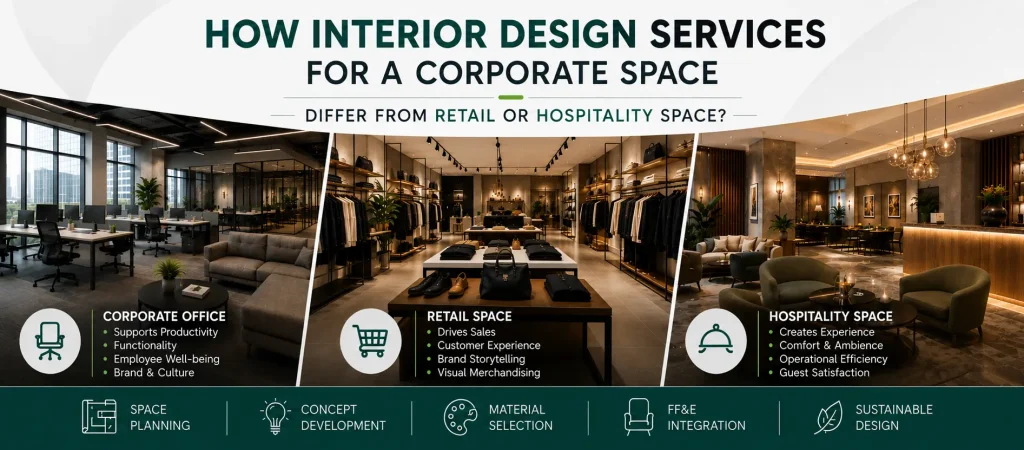
Corporate Office: Where Design Serves Operations
Corporate interior design services are fundamentally about making work happen better. The design of an office environment directly influences how employees communicate, collaborate, focus, and experience the organisation’s culture. It is also increasingly linked to talent attraction and retention in competitive sectors.
The specific demands of corporate interior design include:
• Space planning that reflects how different teams and functions actually interact, not just how they are organised on an organogram
• Acoustic management in open-plan environments where concentration and confidentiality can conflict
• Workplace flexibility that allows spaces to be reconfigured as team sizes and working patterns change
• Brand integration that makes the physical environment consistent with how the company presents itself to clients and recruits
• Compliance with occupational health and safety requirements, including emergency egress, workstation standards, and accessibility
In Gauteng, interior design services for corporate clients need to reflect local commercial property conditions, such as mixed building ages, variable floor plate sizes, and major landlord fit-out guidelines.
Retail: Where Design Drives Revenue
Retail interior design operates on a fundamentally different set of principles. In a retail environment, the design does not support an existing activity, but directly influences purchasing behaviour. Every decision, from circulation routes to lighting temperature to fixture height, is evaluated against its impact on sales.
Interior design services for retail spaces need to address:
• Customer journey mapping that guides shoppers through the space in a sequence that maximises product exposure
• Lighting design that makes product categories look their best and communicates quality at a premium level
• Flexibility for seasonal changes, promotional periods, and evolving product ranges without full redesign
• Brand expression through materials, colour, and spatial experience that creates a distinctive identity in a competitive retail environment
• Durability and maintainability given the high traffic volumes and intensive cleaning regimes of retail environments
Retail interior design services also work on significantly shorter design and construction timelines than corporate fitouts. A retail launch is typically tied to a specific commercial calendar date, and the interior designer is expected to manage the programme as tightly as the design.
Hospitality: Where Design Creates Experience
Hospitality interior design, covering hotels, restaurants, lodges, and similar establishments, is the most experiential of the three sectors. The guest or diner is not visiting to work or to buy a product. They are visiting to feel something: welcomed, relaxed, stimulated, or transported. The design of the space is the primary vehicle for that emotional response.
Interior design services for hospitality environments must manage:
• Guest experience sequencing from arrival through public areas to private spaces, each with its own appropriate atmosphere
• The technical demands of commercial-grade kitchens, bathrooms, and servicing infrastructure that guests never see but always notice when they fail
• Material specifications that can withstand commercial-grade use while maintaining a residential quality of warmth and comfort
• Wayfinding and circulation that allows guests to navigate intuitively without signage cluttering the design
• Furniture and loose item procurement within project budgets that can run to millions of rands for larger properties
FF&E (furniture, fixtures, and equipment) collaboration is involved across hospitality, corporate, and retail interior design, although hospitality projects typically require a more intensive level of coordination with FF&E specialists, brand consultants, and food and beverage concept developers.
Where the Disciplines Overlap
Despite the differences between sectors, good interior design services share a common professional foundation. Dikeamo design services include space planning, concept development, and material and furnishing selection across sectors. Energy efficient building design is also offered, focusing on sustainable, performance-driven architectural solutions based on a consistent analytical design process. selection across sectors because the underlying analytical and design process is the same. What changes is the design language, the technical requirements, and the success criteria applied to each project.
In Gauteng, where commercial property development encompasses major corporate campuses, large-scale retail developments, and growing hospitality investment, interior design services are increasingly expected to operate across these sector boundaries. Mixed-use developments in particular require interior designers who can create distinct environments for retail, office, and hospitality tenants within a single building while maintaining coherence across the whole.
Why Sector Experience Matters More Than Portfolio Size
A strong portfolio of corporate fitouts may not always reflect hands-on experience with specific functional requirements across different sectors, such as F&B compliance standards in restaurant design or landlord fit-out guidelines in major retail environments. While core design principles remain consistent across projects, functional requirements, regulatory conditions, and operational needs can vary significantly by sector.
Portfolio size alone is therefore not always the most reliable indicator of a firm’s suitability for a specific type of project.
When commissioning interior design services, it is important to ask a firm about their experience with your specific sector and project type. For example, a commercial office fitout for a financial services company may have different operational, compliance, and security requirements compared to a technology company office, even though both follow the same underlying design principles.
Frequently Asked Questions
Can one interior design firm handle all three sectors, or should I choose a specialist?
Full-service firms can handle multiple sectors, particularly when their team includes professionals with different sector backgrounds. For highly specialised projects, such as a five-star hotel or a flagship luxury retail store, a sector specialist may bring deeper relevant experience. For most corporate, retail, and mid-market hospitality projects, a full-service firm with demonstrated sector experience is appropriate.
Do interior design services in Gauteng include regulatory compliance and plan submissions?
They should if structural or services changes are involved. Any interior project that modifies the building fabric, services, or fire protection systems requires plans submitted to local authorities. Confirm with your firm whether regulatory submissions are included in their scope of service.
How are interior design services priced differently across sectors?
Pricing reflects scope and complexity. Hospitality projects often involve more bespoke design work and FF&E procurement, which extends the professional services scope. Retail projects often have tighter timelines that require more intensive management. Corporate fitouts are frequently priced on a per-square-metre basis once the scope is well defined. Always confirm what is and is not included before engaging a firm.